
 SEARCH

 English
 Español
 Português


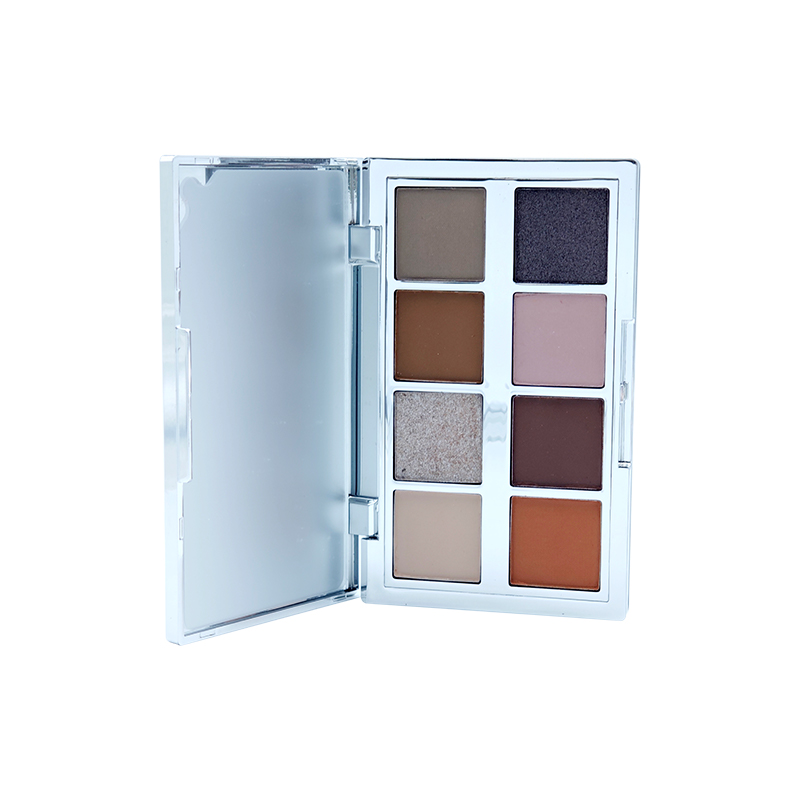
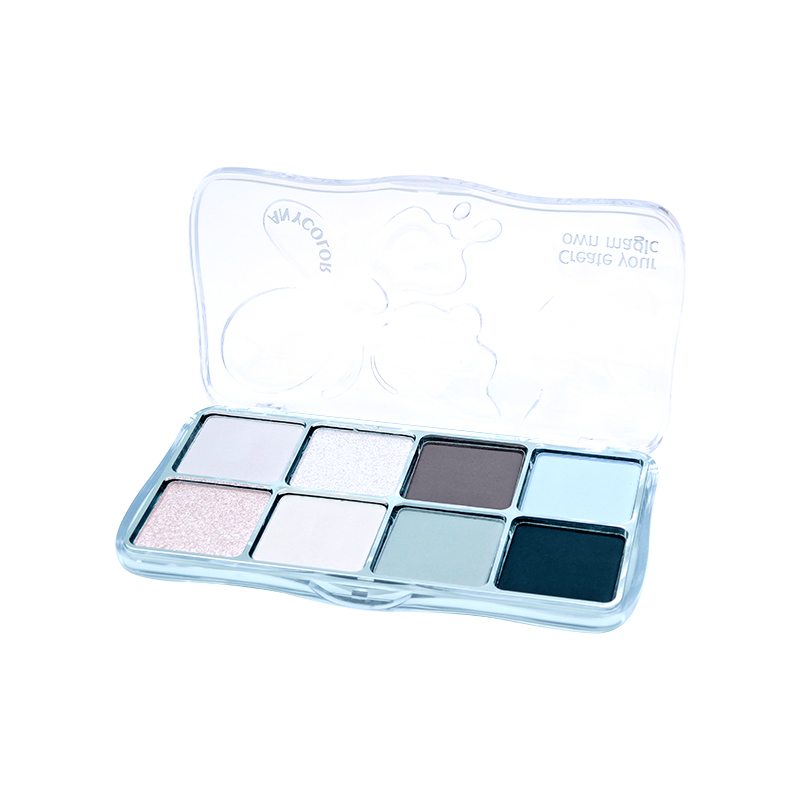
8-Color Neutral Multi-Finish Eyeshadow Palette
Item No.: NF02 Size: 111 X67 X 11 MM NW.: 1...
A highlighter that looked flawless on day one develops a hairline fracture after a week. By the second week a corner has split away, and loose flakes sit in the lid. Cracking in a Baked Powder Highlighter is a familiar complaint, and rough handling explains only part of it. Powder structure, ingredient distribution, the binder system, baking conditions, and packaging all influence how well a pan holds together. Knowing where cracks come from helps consumers care for the product more sensibly. It also helps brands avoid the problem long before a pan reaches a makeup bag.
A baked highlighter combines selected powders with a binding system, then shapes and bakes the mixture. The finished pan has to hold its form while still letting a brush lift product smoothly. Cracks appear when the internal structure cannot cope with pressure, friction, temperature change, or impact.
Binders keep particles connected during storage and use. If the binder is too sparse or unevenly spread, some zones stay loose, and repeated brush contact breaks them into fragments. The formula has to balance cohesion against pickup, since an overly firm pan resists the brush while a weakly bound one crumbles under it.
A surface can look smooth while some areas are more compact than others. Uneven filling or molding creates weak points inside the pan, and cracks tend to start there once the brush returns to the same spot again and again.
High temperatures can affect oils, waxes, and other binding ingredients. Moisture changes how particles interact with moisture-sensitive components. A compact left on a sunny windowsill or beside a steamy bathroom sink faces both risks. The outcome depends on the formula and on how well the packaging shields it.
Everyday habits add up. Pressing a dense brush hard into the pan, loading product from one small spot, dropping the compact on a hard floor, packing it loosely in a crowded bag, or letting other items press against it all contribute to surface damage and deeper fractures.
A finished baked pan is a formed structure of particles and binders, and the arrangement of those parts decides how the powder responds to use. It behaves very differently from loose pigment in a jar.
Ingredients differ in size, shape, and surface character. When they are mixed unevenly, packing varies from zone to zone and the pan reacts unevenly to pressure. Thorough mixing before molding gives a more consistent starting point.
Porosity describes the small spaces inside the powder. Too much open space weakens the links between particles and leaves the pan more vulnerable to friction and knocks. Simply reducing porosity is not the answer either, since the highlighter still needs pleasant pickup and smooth application on skin.
The pan should keep its shape without becoming hard to use. The right level depends on the intended finish, the particle mix, and the application feel the brand wants.
| Product Characteristic | Link to Powder Structure |
|---|---|
| Surface firmness | Resistance to brush pressure |
| Pickup | How easily powder transfers to a brush |
| Application texture | Smoothness and blendability |
| Particle adhesion | Holds the formed structure together |
| Surface appearance | Consistency of the finished pan |
A highlighter may contain mineral powders, pearl pigments, colorants, oils, and binders. Each has different physical behavior, so compatibility matters during development.
Oils, waxes, silicones, or other cosmetic ingredients can serve as binders. Choice matters, but so does distribution. If the binder does not spread evenly, some areas hold together poorly. Development should weigh binding performance, compatibility with other ingredients, spread through the mixture, skin feel, and stability under expected storage.
These improve adhesion to skin and make application smoother. An unsuitable balance or uneven spread can disturb the structure, and temperature can change how some oil-based components behave. A formula should consider the cosmetic finish and the physical behavior of its ingredients during processing and storage.
These create the luminous finish, but particle size, shape, and surface properties also affect how ingredients pack together. A formula that blends several reflective particles needs a binding system that keeps texture consistent without dulling the glow.
Mixing ingredients does not guarantee stability. Some materials behave differently when mixed, heated, cooled, or exposed to moisture. Interactions worth testing include fillers with reflective pigments, binders with minerals, oils with other texture components, and colorants with the surrounding powder system.
A sound formula can still fail if production varies from batch to batch. Small differences at each stage change the internal structure of the finished pan.
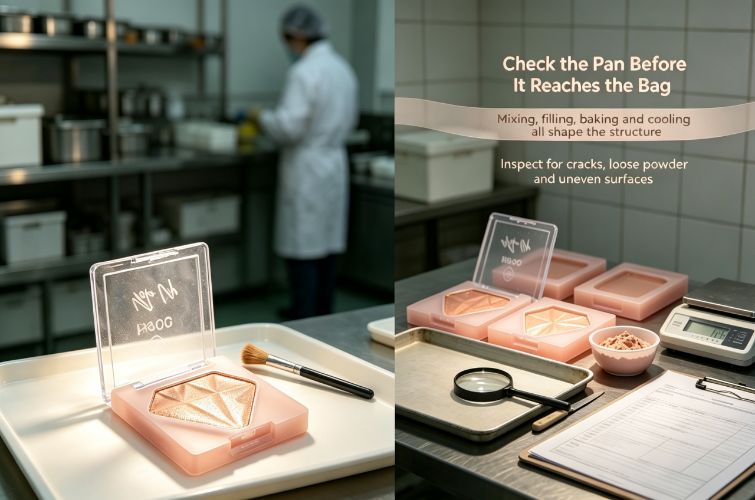
insufficient mixing leaves different proportions of ingredients in different areas, which later shows up as variation in texture, density, and adhesion. Mixing consistency, the order of ingredient addition, and the characteristics of each raw material all count.
before baking, the mixture must be distributed evenly in the pan or mold. Uneven filling produces differences in thickness and density, so one pan may contain zones with different mechanical properties.
temperature and time should match the formula's composition and intended texture. Unsuitable conditions affect moisture removal, ingredient behavior, and final structure. The process should be built around each formula and not copied across products.
pans continue to change while cooling, and rough handling can damage the formed powder. Finished units should be checked for visible cracks, loose powder, and uneven surfaces before packaging.
They matter a great deal. A brush transfers pressure and friction to the powder every time it touches the pan, and dense brushes pressed firmly can disturb the surface over time. Gentle sweeping movements, rotating the pickup spot, tapping off excess powder, and keeping brushes clean all reduce stress.
Store the compact somewhere dry, away from direct sunlight, hot appliances, and places where temperature swings are common, such as a car glove box. Keeping the lid closed limits dust, moisture, and accidental contact.
Packaging also protects the powder in transit and daily use. A well-designed compact supports the pan and cushions it against impact.
| Packaging Element | Practical Function |
|---|---|
| Outer case | Protects against impact |
| Inner pan | Holds and supports the powder |
| Secure lid | Limits dust and accidental contact |
| Internal fit | Reduces movement in transit |
| Protective inserts | Cushion external shocks |
A visually attractive compact still has to give practical protection throughout the life of the product.
Good habits reduce unnecessary stress on the powder, and a few small changes to the routine are usually enough.
Pick up product with light movements and build the glow gradually instead of pressing hard into one spot.
Keep the compact away from sinks, open windows, and direct sunlight, and close it after each use.
Carry it in a separate pouch, keep heavy objects off it, and stop it from shifting around inside a crowded bag with brushes and palettes.
The right response depends on the condition of the pan.
stop pressing the brush into the damaged area and check that the surrounding powder is still firm. Keep the pan dry and avoid further friction. If it remains clean, it can be used gently.
check for contamination first. Avoid using it if the smell or appearance has changed, and replace it if cleanliness cannot be confirmed. Adding water or other liquids can alter the formula and raise hygiene concerns, and repair methods do not suit every baked formula.
Durability starts with formula development. Powders, pigments, binders, and emollients need to be compatible and balanced for cohesion and comfortable application, with interaction testing before production to expose weaknesses early.
Quality control then carries that work through manufacturing:
Packaging should match the physical character of the finished powder. Pan support, case construction, lid closure, and transport protection deserve attention together. This matters for brands creating custom highlighter collections, where visual identity and practical protection must work side by side.
Cracking affects appearance, application experience, and perceived quality. Addressing it means reviewing the whole process, from ingredient compatibility and powder structure to baking conditions and packaging design. Each product concept deserves its own evaluation, because a standard formula rarely suits every finish. Brands developing a new Baked Powder Highlighter or improving an existing formula are welcome to contact our team with their product concept, desired finish, texture preferences, and packaging requirements to discuss a suitable approach.

A highlighter that looked flawless on day one develops a hairline fracture after a week. By the second week a corner ha...
Two highlighters in the same champagne shade can look completely different on the cheekbones. One gives a soft, skin-li...
Zhejiang NiFei Cosmetic Co., Ltd. will exhibit at Cosmoprof Asia 2026, taking place from November 10 to 12, 2026, at th...
A flattering shade can still be uncomfortable when the formula sits thickly on the lips. Tackiness usually traces back ...
A lipstick often looks different in the tube than it does on the lips. Lip Color Changing Lipstick is formulated to de...
Lip makeup no longer has to mean one shade applied edge to edge. A soft tint can give a natural base, and a glossy oil...


 No.333 Caihong Road,Linjiang Industry, Bailongqiao Town,Jinhua City, Zhejiang Province, China
 +86 13750973917+86 18248557685
 [email protected]
Copyright ©Zhejiang NiFei Cosmetic Co., Ltd. Rights Reserved.